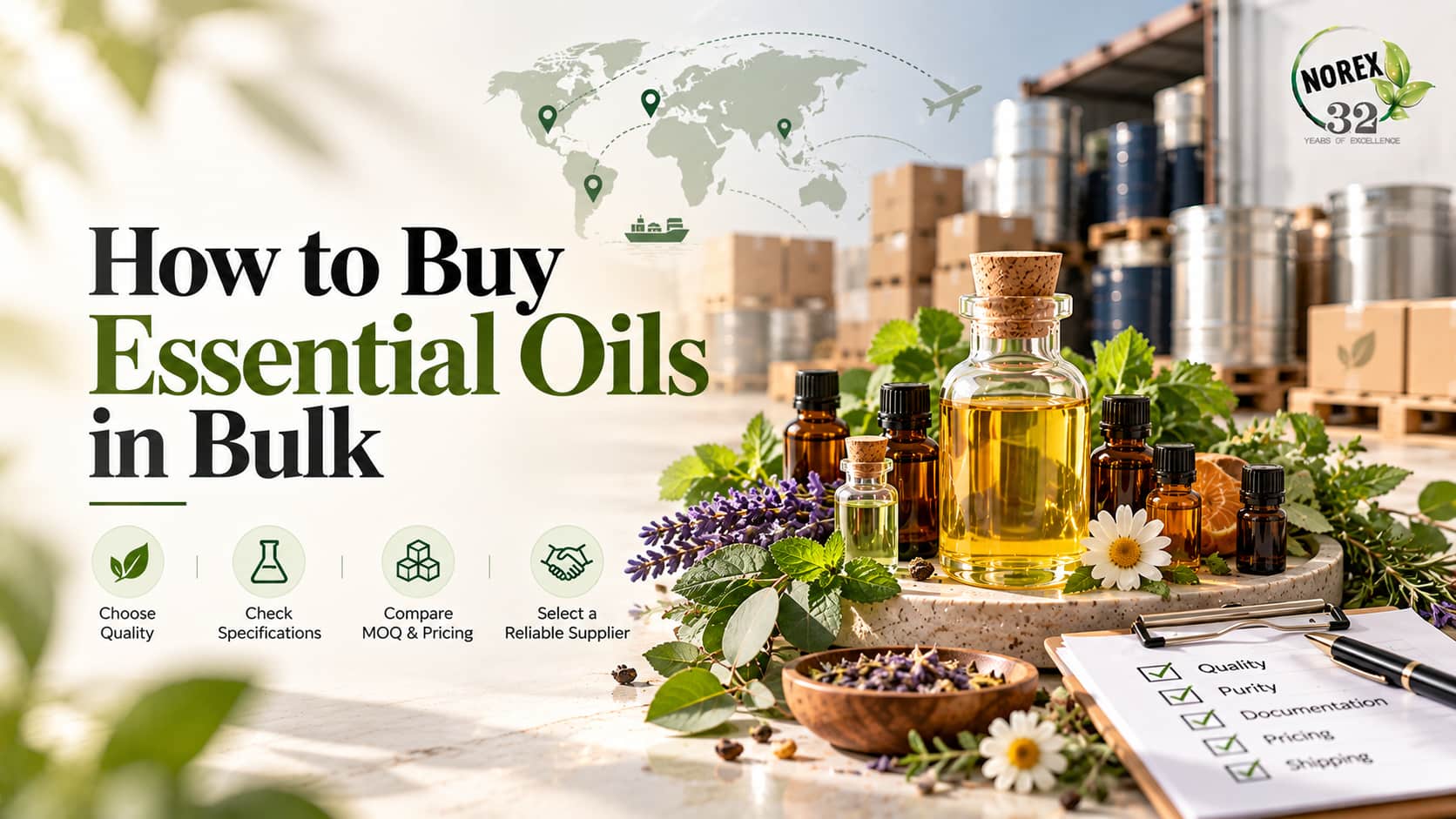
A small sample that smells perfect tells you very little about the full drum that follows it. That gap is where most bulk purchases go wrong. The oil arrives from a different crop year, a different plant variety, or with a quiet dilution, and the problem only shows up once it is inside a finished lotion, candle, or beverage. Knowing how to buy essential oils in bulk is less about finding the lowest quote and more about controlling what you actually receive, drum after drum. You need a written specification, a supplier who can prove what is in the container, and a way to compare each delivery with the batch you approved. This guide follows that process from the first spec sheet to the storage room.
Key Takeaways
• Start with the end product. Skincare, hair care, soap, home fragrance, and flavor work each need a different oil and a different set of documents.
• Put the oil’s identity in writing. Botanical name, plant part, origin, and extraction method belong in the purchase specification.
• Ask for numbers, not adjectives. “Therapeutic grade” is a marketing term, so request measurable ranges for the constituents that matter.
• Tie every document to a batch number. The COA and GC-MS report should match the drums that arrive.
• Approve the real lot and keep a reference. A sealed retained sample becomes your standard for later deliveries.
• Treat a very low quote as a warning. It can point to a different species, a blend, or dilution.
• Protect the oil after delivery. Keep it cool, dark, and sealed with little air space, and take extra care with citrus oils.
Why Bulk Buying Is Different From Buying a Retail Bottle
Small differences turn into large costs
A retail buyer who gets a slightly off bottle loses a few dollars. A manufacturer who gets a slightly off drum can lose a production run. A shift in aroma or composition can change the scent, color, or stability of the finished product.
“Pure” and “therapeutic grade” are not specifications
Many listings for wholesale essential oils lean on phrases like “100% pure” and “therapeutic grade.” There is no official body that grades or certifies an oil as therapeutic grade. It is a marketing term. Purity matters, but it only means something when it is backed by test data for the batch in front of you.
Match the Oil to Your Application First
Start from the finished product
Skincare, hair care, soap, home fragrance, and flavor work all ask different things of an oil. Decide what the oil has to do in your product before you compare suppliers.
Common oils and where they are used
The table below shows how the Norex essential oils range maps to typical applications.
Essential oil | Typical applications |
Lavender oil | Fragrance, perfumes, cosmetics, personal care |
Tea tree oil | Skincare, personal care, cosmetics |
Hair care, cosmetics, aromatic formulations | |
Lemon oil | Flavor, fragrance, cosmetics |
Patchouli oil | Perfumery, fragrance blends, personal care |
Geranium oil | Fine fragrance, skincare, cosmetics |
The same collection also lists soaps and body care, creams and lotions, home fragrance, and diffuser blends as common end uses.
How to Buy Essential Oils in Bulk: Start With the Specification
Name the plant, not just the oil
“Lavender” can mean true lavender, Lavandula angustifolia, or lavandin, Lavandula hybrida, which is sold as a separate oil. Both are legitimate. They are not the same ingredient, so they should never be swapped without retesting your formula. The lavender oil you approve should state its botanical name on every document.
Fix the plant part, origin, and extraction method
The same species can give different oils from different parts of the plant. Origin can change the profile too. Lemon oil comes from the peel and can be cold pressed or steam distilled, and the two versions smell and behave differently. Patchouli oil is steam distilled from the leaves. Put these three details in your purchase specification.
Set the numbers that matter for your product
Decide which constituents drive performance in your application and ask for a range. For tea tree oil, the international standard ISO 4730 sets ranges for terpinen-4-ol and other components. For eucalyptus oil, buyers usually specify cineole content. For clove oil, it is eugenol. A supplier who can quote against a number is easier to hold accountable than one who promises “premium quality.”
How to Buy Essential Oils in Bulk From the Right Supplier
Manufacturer, processor, or trader
Bulk essential oil suppliers fall into three broad groups. Some distill or rectify oils themselves. Some buy crude oil and process, test, and standardize it. Some only trade. Essential oil manufacturers and processors with their own lab can usually answer technical questions directly and trace a batch back to its source.
Certifications that match your end product
Ask for the certificates that apply to your category, not the longest list. Food and beverage buyers typically look for a food safety system such as ISO 22000, FSSC 22000, or HACCP, plus Kosher or Halal where needed. Cosmetic and fragrance buyers should ask about IFRA documentation. Pharmaceutical buyers need GMP evidence. Always request the certificate itself and check its validity date.
Lab capability you can verify
A supplier’s testing is only as good as its equipment and routine. Ask what instruments they run in-house, whether every batch is tested, and whether retained samples are kept. Norex, for example, describes its GC section, microbiology lab, stability studies, and physical chemistry testing on its capabilities page.
Documents to Request Before You Place an Order
Certificate of Analysis (COA)
The COA is the batch’s report card. It should show the batch number, appearance, odor, and physical values such as relative density, refractive index, and optical rotation. Check that results sit inside the agreed range and that the batch number matches the label on the drum.
GC-MS report
Gas chromatography with mass spectrometry separates an oil into its individual constituents and shows the share of each. That lets you compare the batch with a published standard, such as the ISO profile for that oil, and with the batch you approved earlier. For high-value oils, some buyers also send a sample to an independent lab.
Safety data sheet, allergen declaration, and IFRA documents
The safety data sheet covers hazards, flash point, handling, and transport classification. An allergen declaration lists naturally occurring components, such as limonene and linalool, that EU cosmetic rules require on the label above set thresholds. If the oil is going into a scented product, also ask for the IFRA certificate for your product category. Our guide to tulsi oil in personal care and oral care shows why constituent limits matter in practice.
How to Buy Essential Oils in Bulk Without Batch Surprises
Ask for a sample from the lot you will receive
A pre-shipment sample should come from the same batch as your order, with its own COA. If the supplier can only offer a generic sample, treat approval as provisional. Once you approve a batch, keep a sealed portion as your reference for future deliveries.
Test in your own formulation
An oil that passes on paper can still behave differently in your base. Whether it is orange oil for a cleaner or a floral oil for a cream, make a small pilot batch before you commit to full volume.
What Shapes the Essential Oils Wholesale Price
Crop yield and harvest
Price starts in the field, because some plants give far less oil than others. Rose oil is the classic example. Perfumery sources put the requirement at roughly four to five tons of flowers for one kilogram of oil. Harvest size also changes from season to season. Similar forces are explained in our piece on what drives mentha oil prices.
Why a very low quote is a warning
Nobody sells pure essential oils in bulk below the cost of producing them. A quote far under the market can point to a different species, a blend, or dilution. The honest answer is that the cheapest drum is often the most expensive one once it reaches production.
Packaging, Shipping, and Storage for Bulk Essential Oils
Containers and transport
Ask what type of container the oil ships in and how full it will be. Less air in the container means less exposure to oxygen. Some essential oils are classed as flammable liquids for transport, and citrus oils such as orange oil are a common example. That affects freight mode, cost, and transit time. Confirm the classification on the safety data sheet before you plan a launch date around a delivery.
Storage at your site
Store drums cool, dark, and tightly closed, and keep air space to a minimum once a drum is opened. Heat promotes oxidation. Citrus oils are high in limonene, which is especially prone to it, and oxidized oil carries a higher risk of skin sensitization.
How to Buy Essential Oils in Bulk: The Order Process Step by Step
1. Send a clear inquiry. Share the oil, botanical name, quantity, application, and destination.
2. Review the specification and quote. Check that the quoted grade matches your written spec.
3. Approve a sample. Test the lot sample and its COA before you confirm.
4. Confirm the order in writing. Fix quantity, packaging, documents, lead time, and payment terms.
5. Check the delivery. Match batch numbers on the drums and the paperwork, then compare with your retained reference.
Quick Checklist Before You Order
Run through this list each time you work out how to buy essential oils in bulk for a new product.
1. Botanical name, plant part, origin, and extraction method are written into the specification.
2. Key constituents have an agreed range.
3. Certificates relevant to your industry are current and on file.
4. COA and GC-MS report carry the batch number of your lot.
5. Safety data sheet, allergen declaration, and IFRA documents are received where needed.
6. A sample from the actual lot is approved and a reference is retained.
7. Packaging type, transport classification, and lead time are confirmed in writing.
Why Work With Norex
Among essential oils wholesale suppliers, Norex combines sourcing, processing, and testing under one roof. The company has operated since 1994 from a site beside the fields that supply its raw-material crops. You can read the full story on the About page.
• Range: The essential oils collection lists more than 40 oils and absolutes, alongside mint products such as peppermint oil, plus aroma chemicals and fragrances.
• Processing: Distillation, rectification, and fractionation systems, with production areas built to WHO-GMP norms.
• Testing: In-house GC, microbiology, stability, and physical chemistry labs. Norex states that its production is tested twice before release.
• Compliance: The company lists ISO 9001, ISO 14001, ISO 22000, FSSC 22000, HACCP, WHO-GMP, Kosher, Halal, and REACH registration.
• Industry memberships: IFRA, IFEAT, FAFAI, CHEMEXCIL, and EOAI.
• Documentation: Product pages such as lavender and lemon list technical data sheets, COA, MSDS, and allergen declarations.
Conclusion
Learning how to buy essential oils in bulk comes down to replacing trust with evidence. Define the oil precisely. Choose a supplier whose certifications fit your product. Tie every document to a batch number, approve a real sample, and protect the oil once it arrives.
Talk to Norex About Your Bulk Requirement
Share your specification, target volume, and application, and the Norex team will come back with product information and a quote. The company says its specialists respond within one business day. Use the contact page to request a sample or send an inquiry.