Rosemary essential oil is one of the most widely traded herbal aromatic ingredients, yet buyers often receive specifications they cannot easily compare. A perfumer, formulator or procurement manager needs more than a botanical name. They need to know what the oil contains, how it is made, where it performs and how to judge a batch before it enters production. This guide explains all of that in practical terms. It covers rosemary oil applications, chemical composition, use in perfumery, extraction methods and industrial uses, so you can source and specify with confidence.
Key Takeaways
• What it is: Rosemary essential oil comes mainly from steam distillation of Rosmarinus officinalis leaves and flowering tops, and has a fresh, camphoraceous, herbaceous aroma.
• Chemistry: The profile is led by 1,8-cineole, camphor and alpha-pinene. Their ratio defines the chemotype and the scent.
• Perfumery: It works as a top-to-middle note that adds herbal freshness to colognes, fougère accords, soaps and home care fragrances.
• Production: Steam distillation is the dominant commercial method. Distillation time and conditions change the final composition.
• Quality: Judge a batch by GC-MS profile, physical constants, sensory match to a reference, origin and a full certificate of analysis.
What Is Rosemary Essential Oil?
Rosemary essential oil is a volatile, colourless to pale yellow liquid obtained mainly by steam distillation of the leaves and flowering tops of Rosmarinus officinalis. This woody Mediterranean shrub belongs to the Lamiaceae family and is now also listed botanically as Salvia rosmarinus.
The oil smells fresh, camphoraceous and herbal, with a clean woody undertone. Major producing regions include Spain, Morocco, Tunisia and France. Commercial yield is usually around 0.5 to 2 percent of plant weight, depending on origin, harvest time and the condition of the biomass. As an aromatic ingredient, it sits between the cooling character of mint products and the soft herbal sweetness of lavender.
What Is the Chemical Composition of Rosemary Essential Oil?
The chemical composition of rosemary essential oil is dominated by three compounds: 1,8-cineole, camphor and alpha-pinene. Together they usually account for well over half of the oil, with borneol, camphene, beta-pinene, limonene and verbenone making up much of the rest.
Compound | Typical range | Sensory and functional role |
1,8-cineole | 15 to 55% | Fresh, cooling, eucalyptus-like lift |
Camphor | 5 to 31% | Sharp, medicinal, penetrating note |
Alpha-pinene | 9 to 26% | Piney, resinous, bright top note |
Camphene and beta-pinene | 3 to 12% combined | Woody, terpenic support |
Borneol and bornyl acetate | 2 to 8% combined | Rounded, balsamic depth |
Verbenone | Up to 2.5% (higher in some chemotypes) | Warm, herbaceous nuance |
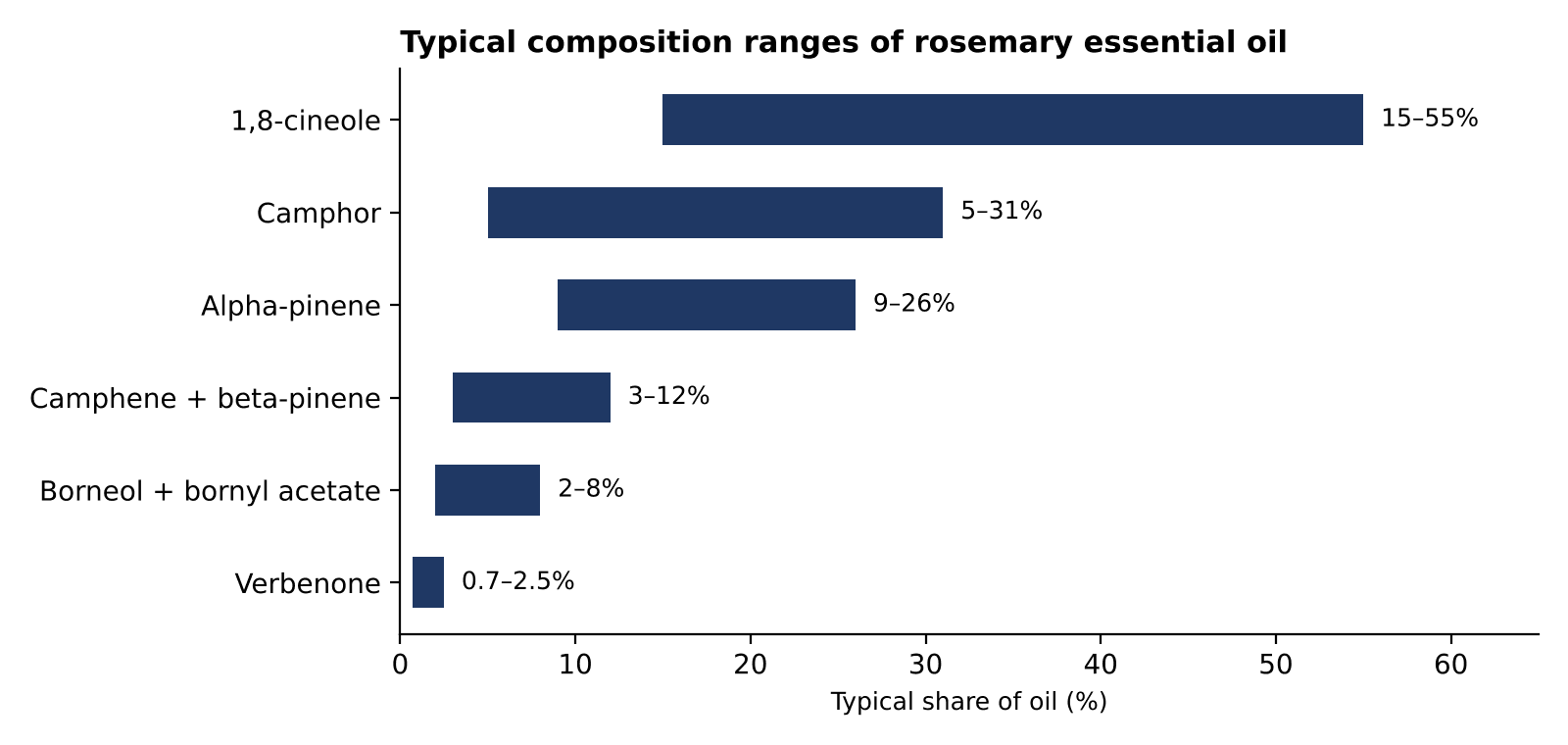
Ranges are indicative and vary by origin, harvest and distillation. Moroccan and Tunisian oils tend to be rich in 1,8-cineole, while Spanish oils carry a more balanced camphor and alpha-pinene profile. A verbenone chemotype also exists and smells softer and sweeter.
Because 1,8-cineole drives so much of the character, it is worth knowing the pure compound as well. Norex lists Eucalyptol (1,8 Cineole) among its aroma chemicals, which helps formulators understand how this single molecule behaves on its own.
How Is Rosemary Essential Oil Extracted?
Rosemary oil extraction methods are led by steam distillation, which remains the standard for commercial essential oil. Steam passes through the plant material, carries the volatile compounds into a condenser, and the oil separates from the water.
Four methods are worth distinguishing:
• Steam distillation: The industry standard. It gives a clean oil that meets published specifications such as ISO 1342.
• Hydrodistillation: Plant material boils directly in water. It is simpler, but can darken the oil or alter heat-sensitive components.
• Supercritical CO2 extraction: Produces a fuller, less heat-altered extract, but equipment cost is high and the result differs from a distilled oil.
• Solvent extraction: Yields oleoresins rich in carnosic acid, used mainly as antioxidants. These are not the same as essential oil.
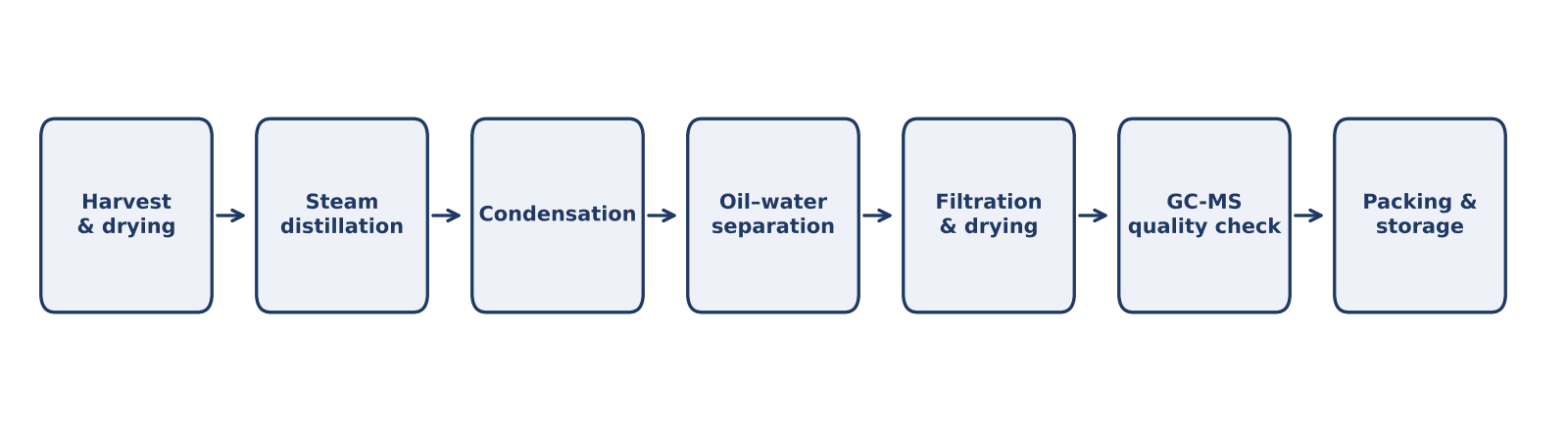
Distillation time matters. Light terpenes such as alpha-pinene come over first, while heavier compounds such as borneol and bornyl acetate appear later. A controlled process therefore gives a more repeatable profile. You can read how Norex approaches distillation and refining on its capabilities page.
How Is Rosemary Essential Oil Used in Perfumery?
In perfumery, rosemary essential oil acts as a top-to-middle note that adds herbal freshness, lift and a clean, slightly camphoraceous edge. It is a classic ingredient in colognes, aromatic fougère accords and masculine fragrances.
Perfumers pair it with lavender, bergamot, lemon, pine, cedarwood, geranium and oakmoss to build a green, outdoor character. In fragrance formulation, it is dosed carefully because camphor and cineole can dominate a blend quickly. Use levels must also comply with IFRA standards for the finished product category.
Norex supplies fragrance creations for personal care, home care and fine fragrance, and aromatic ingredients such as lavender oil that sit naturally beside rosemary in herbal accords.
What Are the Main Rosemary Oil Applications?
Rosemary oil applications span fragrance, personal care, flavours, wellness and household products. The oil is valued for its aroma and for the functional reputation of its main constituents.
• Personal care: Shampoos, conditioners, scalp products, soaps and body washes use it for a fresh herbal scent. Hair care fragrances are a common route.
• Home care: Cleaners, air fresheners and laundry products use it for a clean, outdoor note. Air care and home care ranges use it widely.
• Flavours: Trace levels appear in savoury seasonings and meat flavour systems, subject to local food regulations.
• Wellness and aromatherapy: Diffusion blends and massage oils use it for its invigorating aroma.
• Topical and pharmaceutical products: Balms and rubs use it alongside other camphoraceous ingredients.
What Are the Industrial Uses of Rosemary Essential Oil?
Rosemary oil industrial uses centre on scenting and functional formulation at scale. Manufacturers value it because it is plant-derived, blends well and has a recognisable, consumer-friendly aroma.
Soap and detergent makers use it to build herbal profiles at low cost per kilogram of finished product. Household and industrial cleaner brands use it to give a fresh, natural impression. It also appears in odour-masking systems, natural-positioned insect repellent blends and animal care products. In many of these applications it works alongside other functional oils such as tea tree oil. Browse the full range of essential oils to see how these ingredients are grouped.
How to Evaluate Rosemary Essential Oil Quality for Manufacturing
To evaluate rosemary essential oil quality, check its identity, GC-MS composition, physical constants and aroma against an approved reference, then confirm documentation and batch traceability. Essential oil quality parameters should be agreed in writing before the first order.
1. Botanical identity and origin: Confirm Rosmarinus officinalis, country of origin and crop year.
2. GC-MS profile: Compare 1,8-cineole, camphor, alpha-pinene and borneol against the chemotype you need, or against ISO 1342 limits.
3. Physical constants: Check relative density (roughly 0.89 to 0.92 at 20°C), refractive index and optical rotation against the supplier specification.
4. Sensory evaluation: A trained evaluator should match each batch to an approved standard for top note, body and dry-down.
5. Adulteration screening: Watch for added synthetic camphor, eucalyptus oil or cineole fractions. Chiral GC analysis helps detect them.
6. Documentation: Request a certificate of analysis, safety data sheet, allergen declaration, IFRA statement and batch number.
7. Storage and stability: Oils should arrive in sealed, airtight containers, protected from light, heat and oxygen.
Need a rosemary oil specification or sample? Share your target chemotype, application and annual volume with the Norex team at marketing@norex.in or +91 8077634394, and request a specification sheet, certificate of analysis and sample for your formulation trials. |
Why Source Aromatic Ingredients from Norex Flavours?
Norex has supplied flavours, fragrances and essential oils to food, personal care, beverage and pharmaceutical companies since 1994. Its site lists these strengths:
8. Farm-to-formula sourcing: Direct partnerships with farmers support traceability from field to finished product.
9. In-house R&D laboratory: A dedicated team develops custom blends and aroma chemical solutions.
10. Certified production: Norex lists ISO, FSSAI, Kosher, Halal, GMP and USDA Organic certified lines.
11. Custom formulations: Flavour and fragrance solutions are built to your sensory and regulatory brief.
12. Export capability: Shipments reach more than 50 countries with compliant documentation.
To discuss rosemary oil or any other aromatic ingredient for your formulation, contact the Norex team at marketing@norex.in or +91 8077634394.
Sources and standards referenced: ISO 1342, Essential oils: Rosemary oil; IFRA Standards for fragrance ingredient use; Tisserand and Young, Essential Oil Safety (2nd edition); Surburg and Panten, Common Fragrance and Flavor Materials (Wiley-VCH).
Conclusion: Specify Rosemary Oil by Chemistry, Not Just Name
Rosemary essential oil rewards buyers who look beyond the label. Its character comes from the balance of 1,8-cineole, camphor and alpha-pinene, and that balance depends on origin, chemotype and distillation. Steam distillation remains the most reliable route to a consistent oil, and perfumers, personal care brands and industrial formulators all rely on it for herbal freshness.
When you source, agree on the GC-MS profile, physical constants, sensory reference and documentation up front. That simple discipline protects batch consistency and regulatory compliance. Start with a clear specification, test every lot, and work with a supplier that can support both.
Ranges are indicative and vary by origin, harvest and distillation. Moroccan and Tunisian oils tend to be rich in 1,8-cineole, while Spanish oils carry a more balanced camphor and alpha-pinene profile. A verbenone chemotype also exists and smells softer and sweeter.
Because 1,8-cineole drives so much of the character, it is worth knowing the pure compound as well. Norex lists Eucalyptol (1,8 Cineole) among its aroma chemicals, which helps formulators understand how this single molecule behaves on its own.
How Is Rosemary Essential Oil Extracted?
Rosemary oil extraction methods are led by steam distillation, which remains the standard for commercial essential oil. Steam passes through the plant material, carries the volatile compounds into a condenser, and the oil separates from the water.
Four methods are worth distinguishing:
• Steam distillation: The industry standard. It gives a clean oil that meets published specifications such as ISO 1342.
• Hydrodistillation: Plant material boils directly in water. It is simpler, but can darken the oil or alter heat-sensitive components.
• Supercritical CO2 extraction: Produces a fuller, less heat-altered extract, but equipment cost is high and the result differs from a distilled oil.
• Solvent extraction: Yields oleoresins rich in carnosic acid, used mainly as antioxidants. These are not the same as essential oil.
Distillation time matters. Light terpenes such as alpha-pinene come over first, while heavier compounds such as borneol and bornyl acetate appear later. A controlled process therefore gives a more repeatable profile. You can read how Norex approaches distillation and refining on its capabilities page.
How Is Rosemary Essential Oil Used in Perfumery?
In perfumery, rosemary essential oil acts as a top-to-middle note that adds herbal freshness, lift and a clean, slightly camphoraceous edge. It is a classic ingredient in colognes, aromatic fougère accords and masculine fragrances.
Perfumers pair it with lavender, bergamot, lemon, pine, cedarwood, geranium and oakmoss to build a green, outdoor character. In fragrance formulation, it is dosed carefully because camphor and cineole can dominate a blend quickly. Use levels must also comply with IFRA standards for the finished product category.
Norex supplies fragrance creations for personal care, home care and fine fragrance, and aromatic ingredients such as lavender oil that sit naturally beside rosemary in herbal accords.
What Are the Main Rosemary Oil Applications?
Rosemary oil applications span fragrance, personal care, flavours, wellness and household products. The oil is valued for its aroma and for the functional reputation of its main constituents.
• Personal care: Shampoos, conditioners, scalp products, soaps and body washes use it for a fresh herbal scent. Hair care fragrances are a common route.
• Home care: Cleaners, air fresheners and laundry products use it for a clean, outdoor note. Air care and home care ranges use it widely.
• Flavours: Trace levels appear in savoury seasonings and meat flavour systems, subject to local food regulations.
• Wellness and aromatherapy: Diffusion blends and massage oils use it for its invigorating aroma.
• Topical and pharmaceutical products: Balms and rubs use it alongside other camphoraceous ingredients.
What Are the Industrial Uses of Rosemary Essential Oil?
Rosemary oil industrial uses centre on scenting and functional formulation at scale. Manufacturers value it because it is plant-derived, blends well and has a recognisable, consumer-friendly aroma.
Soap and detergent makers use it to build herbal profiles at low cost per kilogram of finished product. Household and industrial cleaner brands use it to give a fresh, natural impression. It also appears in odour-masking systems, natural-positioned insect repellent blends and animal care products. In many of these applications it works alongside other functional oils such as tea tree oil. Browse the full range of essential oils to see how these ingredients are grouped.
How to Evaluate Rosemary Essential Oil Quality for Manufacturing
To evaluate rosemary essential oil quality, check its identity, GC-MS composition, physical constants and aroma against an approved reference, then confirm documentation and batch traceability. Essential oil quality parameters should be agreed in writing before the first order.
1. Botanical identity and origin: Confirm Rosmarinus officinalis, country of origin and crop year.
2. GC-MS profile: Compare 1,8-cineole, camphor, alpha-pinene and borneol against the chemotype you need, or against ISO 1342 limits.
3. Physical constants: Check relative density (roughly 0.89 to 0.92 at 20°C), refractive index and optical rotation against the supplier specification.
4. Sensory evaluation: A trained evaluator should match each batch to an approved standard for top note, body and dry-down.
5. Adulteration screening: Watch for added synthetic camphor, eucalyptus oil or cineole fractions. Chiral GC analysis helps detect them.
6. Documentation: Request a certificate of analysis, safety data sheet, allergen declaration, IFRA statement and batch number.
7. Storage and stability: Oils should arrive in sealed, airtight containers, protected from light, heat and oxygen.
Need a rosemary oil specification or sample? Share your target chemotype, application and annual volume with the Norex team at marketing@norex.in or +91 8077634394, and request a specification sheet, certificate of analysis and sample for your formulation trials. |
Why Source Aromatic Ingredients from Norex Flavours?
Norex has supplied flavours, fragrances and essential oils to food, personal care, beverage and pharmaceutical companies since 1994. Its site lists these strengths:
8. Farm-to-formula sourcing: Direct partnerships with farmers support traceability from field to finished product.
9. In-house R&D laboratory: A dedicated team develops custom blends and aroma chemical solutions.
10. Certified production: Norex lists ISO, FSSAI, Kosher, Halal, GMP and USDA Organic certified lines.
11. Custom formulations: Flavour and fragrance solutions are built to your sensory and regulatory brief.
12. Export capability: Shipments reach more than 50 countries with compliant documentation.
To discuss rosemary oil or any other aromatic ingredient for your formulation, contact the Norex team at marketing@norex.in or +91 8077634394.
Sources and standards referenced: ISO 1342, Essential oils: Rosemary oil; IFRA Standards for fragrance ingredient use; Tisserand and Young, Essential Oil Safety (2nd edition); Surburg and Panten, Common Fragrance and Flavor Materials (Wiley-VCH).
Conclusion: Specify Rosemary Oil by Chemistry, Not Just Name
Rosemary essential oil rewards buyers who look beyond the label. Its character comes from the balance of 1,8-cineole, camphor and alpha-pinene, and that balance depends on origin, chemotype and distillation. Steam distillation remains the most reliable route to a consistent oil, and perfumers, personal care brands and industrial formulators all rely on it for herbal freshness.
When you source, agree on the GC-MS profile, physical constants, sensory reference and documentation up front. That simple discipline protects batch consistency and regulatory compliance. Start with a clear specification, test every lot, and work with a supplier that can support both.