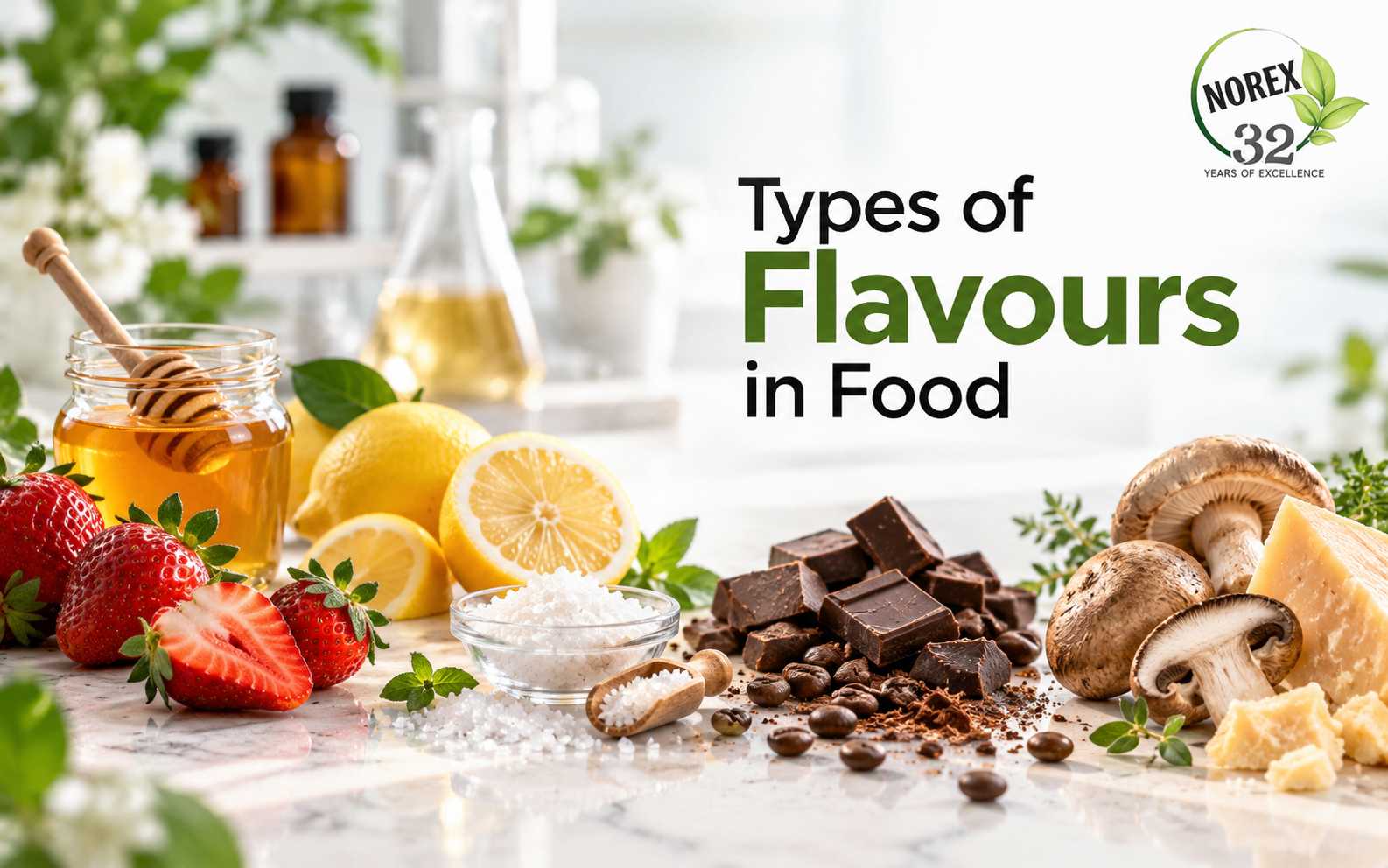
The types of flavours in food fall into three working groups: by taste, by origin, and by physical form. Taste covers sweet, sour, salty, bitter, and umami. Origin covers natural, nature-identical, and artificial. Form covers liquid, powder, emulsion, oleoresin, and encapsulated flavours.
Most reformulation cycles fail not because someone picked a bad flavour, but because they picked the wrong category of flavour. A liquid strawberry that shines in a cold-fill beverage can collapse in a 190°C biscuit bake, and a natural extract that wins the sensory panel can break the cost target at scale.
So before you request a sample, know which axis you are choosing on. This guide covers all flavour categories the way a flavourist thinks about them.
Key Takeaways
· The types of flavours in food are best classified three ways: by taste, by origin, and by form.
· Flavour is taste plus aroma plus mouthfeel, and aroma carries most of the perception.
· A flavor profile covers all three sensory inputs; a taste profile covers only the five basic tastes.
· The five confirmed tastes are sweet, sour, salty, bitter, and umami, with kokumi used as a sixth effect.
· Origin sets your label claim, cost, and stability at the same time.
· Physical form decides process survival: liquid for cold, spray dried for heat and long shelf life.
· Every application segment has one dominant constraint; identify it first.
· Specify the profile in writing before requesting samples; validate dosage and shelf life by trial.
What Is Flavour? Flavour Meaning in Food Beyond Taste
Flavour is the combined sensory impression of taste, aroma, and mouthfeel. Most people assume flavour happens on the tongue, which in fact contributes the smallest share.
Taste receptors detect only five confirmed qualities. Aroma is detected in the nasal cavity, including when volatile compounds travel up from the back of the mouth while chewing. That route, retronasal olfaction, delivers most of what you call flavour.
The trigeminal nerve supplies the third input, registering physical and chemical sensation rather than taste: the pungency of chilli, the cooling of menthol, the astringency of tannins.
This matters commercially. When a flavour in your flavour food application tastes flat, the cause is usually a missing aroma fraction, not a missing taste.
What Is a Flavor Profile?
A flavor profile is the structured description of how a flavour is perceived over time: its character, intensity, and the order its notes appear in. It is the specification sheet of a sensory experience.
Flavourists build a profile in three layers, borrowed from perfumery:
1. Top notes — the first impression, 0 to 10 seconds. Volatile esters and citrus terpenes such as limonene. Bright, fast, and the first to disappear in processing.
2. Middle notes — the body, 10 to 60 seconds. Where the flavour is identified as mango, vanilla, or butter. Vanillin and diacetyl sit here.
3. Base notes — the finish. Heavier aldehydes, lactones, and Maillard reaction products giving roasted, creamy, or caramelised depth.
Two suppliers can both sell "natural mango" and deliver entirely different flavor profiles. Reviewing all flavor profiles against a written target, not against memory, keeps a reformulation honest.
Difference Between Taste Profile and Flavor Profile
These terms get used interchangeably, and should not be. The difference between taste profile and flavor profile is scope: a taste profile covers only the five basic tastes; a flavor profile covers taste plus aroma plus mouthfeel.
Dimension | Taste profile | Flavor profile |
Sensory inputs | Tongue receptors only | Taste, aroma, and trigeminal response |
Descriptors used | Sweet, sour, salty, bitter, umami | Fruity, green, roasted, creamy, woody, and hundreds more |
Typical use | Sweetener systems, acidity balance, salt reduction | Full flavour development and matching |
Measured by | Intensity scoring of five attributes | Descriptive panels and GC-MS analysis |
A brief specifying only a taste profile covers roughly a fifth of the sensory experience.
The Five Basic Tastes, and the Sixth Everyone Argues About
Every flavour variant is built on five confirmed tastes.
· Sweet — signals energy. Delivered by sugars, polyols, or high-intensity sweeteners.
· Sour — signals acidity, from citric, malic, lactic, or phosphoric acid. Critical to perceived freshness in fruit.
· Salty — signals electrolytes. Sodium and potassium salts, which also suppress bitterness.
· Bitter — an evolutionary warning signal. Present in caffeine, quinine, hop acids, and many plant and protein systems.
· Umami — savoury depth from glutamates and nucleotides. Found in tomato, cheese, mushroom, soy, and yeast extract.
The disputed sixth is kokumi, a Japanese concept describing thickness and continuity rather than a taste of its own. Produced by certain peptides, it rounds out reduced-sodium and plant-protein products. It is not formally recognised as a basic taste, but it reads clearly on a panel.
Types of Flavours in Food by Origin
Origin is the classification regulators and labels care about most, and it drives both cost and claim. Under FSSAI rules in India and comparable US and EU frameworks, these categories are legally defined, not marketing terms.
Natural flavours come from plant or animal sources via physical, enzymatic, or microbiological processes. Strongest clean-label claim, highest cost, variable by harvest.
Nature-identical flavours are chemically identical to natural compounds but produced synthetically. Nature-identical vanillin is the same molecule as vanillin from a vanilla bean. Cost and consistency improve sharply; the natural claim is lost.
Artificial flavours are compounds not found in nature, such as ethyl maltol. They offer the highest stability, lowest cost, and effects natural sources cannot reproduce. Safety is governed by positive lists and FEMA GRAS.
Origin type | Relative cost | Label claim | Heat stability | Best for |
Natural | High | "Natural flavour" | Low to moderate | Premium, clean-label, short shelf life |
Nature-identical | Moderate | "Flavour" | Moderate to high | Mainstream volume products |
Artificial | Low | "Artificial flavour" | High | Confectionery, long shelf life, high-process |
Most commercial systems blend categories, and a supplier carrying natural and artificial food flavours in one portfolio lets you tune cost and claim without switching vendors mid-project.
Types of Flavour by Physical Form
Form, the most underestimated category, decides whether a flavour survives your process line.
· Liquid flavours — compounds in a carrier such as propylene glycol, ethanol, or triglycerides. Easy to dose, ideal for cold use, most heat-sensitive.
· Water-soluble emulsions — flavour oil dispersed in water with an emulsifier. Standard for cloudy beverages, where they also contribute opacity.
· Oleoresins — concentrated spice extracts carrying volatile aroma and non-volatile pungency. Very high strength, dosed at low ppm.
· Powder flavours — flavour adsorbed onto a dry carrier such as maltodextrin or salt. Suited to dry blends, seasonings, and premixes.
· Encapsulated or spray dried flavours — flavour locked inside a dried carrier matrix. Spray dried flavour granules shield volatiles from oxygen, moisture, and heat, then release on hydration or chewing.
The practical rule: the hotter, drier, or longer-shelf-life your process, the further down this list you move. Liquid for a chilled RTD, spray dried for an instant premix or extruded snack.
Different Types of Flavours in Food Industry, by Application
In the food industry, flavour categories are organised by the application carrying them. Each segment has one non-negotiable constraint.
· Beverages — water solubility, plus clarity or controlled cloud, and acid stability at low pH. An energy drink flavour must also mask caffeine and taurine bitterness.
· Bakery — bake stability above 180°C. Encapsulated and oleoresin forms survive; delicate top notes do not.
· Dairy and ice cream — cold-temperature release and fat-phase compatibility. Perception drops as temperature falls, so dosage runs higher.
· Confectionery — tolerance of high-temperature cooking and very low water activity. Artificial and nature-identical flavours dominate.
· Savoury and snacks — powder and oleoresin forms that distribute evenly over a surface, plus umami and kokumi support.
· Nutraceuticals — aggressive masking of vitamins, minerals, and proteins. The hardest brief in the category.
Flavor Guide: How to Choose and Combine Different Flavors
Use this flavor guide as a sequence — each answer narrows the next.
4. Define the target profile in writing. Name the top, middle, and base notes you want, and the off-notes you will not accept. Comparing different flavor profiles against a written target removes most of the back-and-forth.
5. Fix the claim before the cost. Decide natural, nature-identical, or artificial first; it constrains everything downstream.
6. Match the form to the harshest step, not the average process condition.
7. Check the pH and the base. Protein, fat, and alkalinity shift perception. A flavour approved in water reads differently in a 12% protein matrix.
8. Dose to the application, not the datasheet. Liquids typically run 0.05% to 0.5%, oleoresins far lower in ppm. Confirm by trial.
9. Combine with a purpose. Pair flavours sharing compound families for a seamless blend, or contrast them for complexity. Vanilla softens acidity; a top note lifts a flat profile.
10. Run accelerated shelf-life early. A flavour that is correct on day one and gone on day ninety has not passed.
Customizing food flavour to consumer demand is worth reading if marketing still shapes your brief.
Conclusion
Once you place a flavour on all three axes, the types of flavours in food stop being a long list and become a short decision tree. You stop asking which flavour tastes best in isolation, and start asking which category survives your process, carries your claim, and holds your cost.
That shift usually saves several sample rounds. When you are ready to move from category to sample, Norex Flavours works as a bulk food flavour manufacturer in India across liquid, powder, emulsion, and spray dried formats, with natural and artificial options in one portfolio.