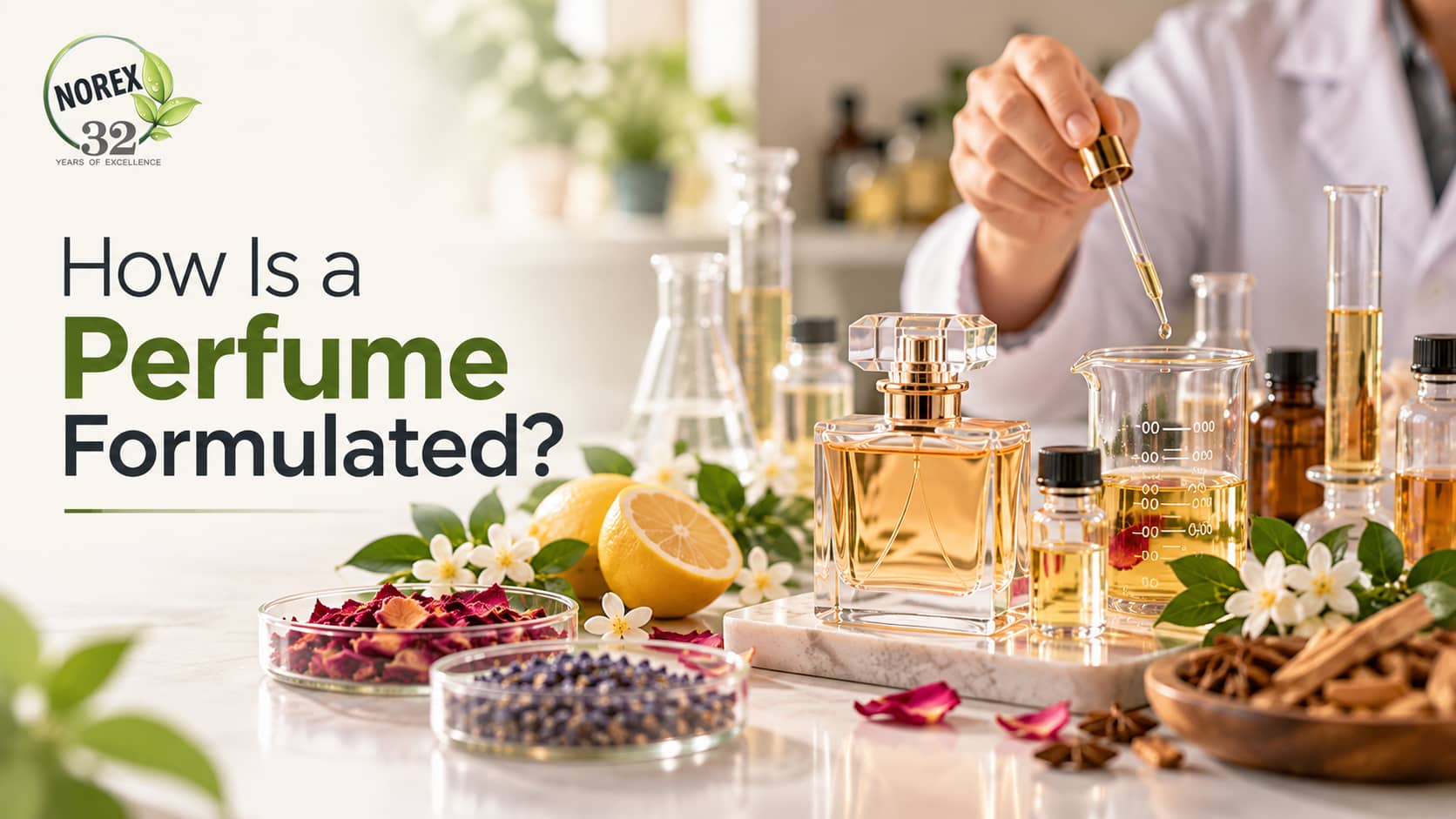
Most people meet a perfume as a finished thing: a bottle, a name, a smell that either works on them or does not. Behind it sits a document that looks more like a recipe card than a work of art. It is a list of raw materials, each with a weight, that adds up to one fragrance concentrate. Getting that list right is the hard part. A scent that smells balanced on a paper strip can turn sharp in alcohol, fade in a lotion or discolor a white soap within weeks. Perfume formulation is the work of solving those problems before the product reaches a shelf. It combines a creative idea with chemistry, safety limits and cost targets, and it usually takes many rounds of trial. This guide walks through each stage in order, from the first brief to the production batch, so brand owners and product developers know what happens and what to ask for.
Key Takeaways
• A perfume starts as a written formula. It lists every raw material by weight and adds up to one fragrance concentrate.
• The brief sets the direction. Product type, target user, cost and markets decide which materials a perfumer can use.
• Raw materials come from two main sources. Naturals such as essential oils and absolutes, and aroma chemicals, which are single molecules.
• Structure comes from notes and accords. Top, heart and base materials evaporate at different speeds, and accords blend several materials into one recognizable smell.
• Concentration defines the product type. Parfum typically carries 20 to 30% fragrance, eau de parfum 15 to 20% and eau de toilette 5 to 15%.
• Testing removes most trial versions. Stability, behavior in the product base and safety limits all have to pass.
• Approval is not the finish line. The formula still has to be scaled up and matched batch after batch.
What perfume formulation actually means
Perfume formulation is the process of deciding which aromatic materials go into a fragrance, and in what proportions, so the result smells right, stays stable and is safe to use. The output is a formula, not a bottle.
Formula, concentrate and finished perfume
Three terms get mixed up. The formula is the written list of materials and weights. The fragrance concentrate, also called the compound or perfume oil, is what you get when those materials are blended. The finished perfume is that concentrate diluted in alcohol, or dosed into a base such as a shampoo, soap or detergent.
A fragrance supplier normally sells the concentrate. The brand or its filler turns it into the final product.
Who is involved
The perfumer writes the formula. An evaluator smells each version against the brief and against competing products. An application lab then tests the concentrate in the real product base. On small projects, one or two people may cover all three roles.
Step 1: The brief that starts every perfume formulation
No perfumer starts with a blank page. The work begins with a brief from the brand, and a vague brief is the most common reason projects drag.
What a useful brief contains
• The product type: fine fragrance, body mist, shampoo, fabric conditioner or something else
• The target user and the mood the scent should create
• Reference scents you like, and ones you want to avoid
• A target cost per kilogram of concentrate
• The markets where the product will be sold
• Any color, pack or claim constraints, such as a clear liquid or a white cream
Why the product base changes everything
A scent written for an alcohol-based fine fragrance cannot simply be dropped into a personal care lotion or a fabric care detergent. Alkaline soap bases break down some materials. Surfactants mute others. Tell your supplier the base on day one. It saves weeks.
Step 2: Choosing raw materials for the formula
A large fragrance house may keep more than a thousand materials in its palette. The ingredients for making perfume fall into three groups, and suppliers of perfume making raw materials should provide a specification and safety data for each one.
Natural materials
Essential oils, absolutes and resins come from plants by steam distillation, cold pressing or solvent extraction. Citrus oils such as bergamot give a bright opening. Florals such as jasmine absolute sit in the heart. Leaves and roots such as patchouli and vetiver hold the base. Naturals bring depth, but they vary from harvest to harvest and often cost more.
Aroma chemicals
Aroma chemicals are single molecules, either made by synthesis or isolated from natural oils. Linalyl acetate gives a soft, lavender-like lift. Benzyl acetate adds a fruity, floral note often used in jasmine-type scents. Vanillin sweetens a base.
They give the perfumer control: the same smell, at the same strength, in every drum. The idea that a natural formula is automatically better or safer does not hold up. Both groups include materials with usage limits.
Solvents and fixatives
Some materials are solids or thick resins and need a carrier solvent before they will blend. Fixatives are slow-evaporating materials that help lighter notes last longer on skin or fabric.
Step 3: Building the structure with notes and accords
Top, heart and base notes
Materials evaporate at different speeds. Light ones are smelled first and fade first. Heavy ones arrive late and stay. Perfumers sort them into top, heart and base notes, and our guide to fragrance types, families and notes covers each layer. During formulation, the job is balance among the three, so the scent does not collapse after the first ten minutes.
Accords
An accord is a small blend of materials that smells like one thing: a rose, a sea breeze, fresh-cut grass. Perfumers build accords first and then combine them. It is faster, and easier to fix, than adjusting dozens of single materials at once.
Writing the formula in parts
A perfume formula is usually written in parts by weight, often totaled to 1,000. A material at 150 parts makes up 15% of the concentrate. A very strong one may appear at 1 part or less, sometimes pre-diluted so it can be weighed accurately.
Step 4: Setting concentration in a perfume formulation
Concentration means how much concentrate goes into the finished product. For alcohol-based perfumes, the commonly cited ranges are:
Product type | Typical fragrance concentration |
Parfum / extrait | 20 to 30% |
Eau de parfum | 15 to 20% |
Eau de toilette | 5 to 15% |
Eau de cologne | 2 to 4% |
Eau fraiche | 1 to 3% |
These are trade conventions, and brands set their own levels, so the ranges overlap in practice. No single perfume making formula fits every format.
Fine fragrance versus functional products
Home care and wash-off products use much smaller doses than a perfume, and the base is harder on the scent. A higher dose is not always the fix. Sometimes the answer is a different material that survives the base.
Cost follows concentration
Every extra percent of concentrate adds cost to each unit. Agree on the dose before you approve the scent, because a fragrance judged at 20% will smell thinner at 10%.
Step 5: Trials, maturation and testing
Trial versions
First trials rarely match the brief. The perfumer adjusts and resubmits, and a project can run through dozens of versions, sometimes far more. Creation can take months, and for major launches it can take years.
Maturation and maceration
Once blended, the concentrate rests so the materials settle together. After dilution in alcohol it rests again. This stage is called maceration and can take weeks to months. The liquid is then chilled and filtered before filling.
Stability and compatibility testing
Samples are stored warm, cold and under light, then checked for changes in smell, color and clarity. Vanillin, for example, is known to turn pale bases yellow or brown over time, so a white cream needs a different approach. Compatibility tests check the scent in the actual base and the actual pack.
Step 6: Safety and compliance checks
IFRA Standards
The IFRA Standards are the global benchmark for fragrance ingredient safety. They prohibit some materials and restrict others, with limits that depend on the product category. A level that is acceptable in a rinse-off product can be too high for a leave-on lotion. Ask your supplier for an IFRA certificate that states the maximum use level for your product type.
Allergen labeling
Some markets require specific fragrance allergens to be named on the pack. Under Regulation (EU) 2023/1545, the European list of fragrance allergens that need individual labeling grew from 24 to 80. Labeling applies above 0.001% in leave-on products and above 0.01% in rinse-off products. Rules differ by market, so confirm the requirements for each place you plan to sell.
Step 7: From approved perfume formulation to production
Scale-up
A formula weighed in grams must behave the same in a tank holding hundreds of kilograms. Order of addition, mixing time and temperature are fixed in a batch record so every run follows the same steps.
Batch-to-batch quality control
Each production batch is compared with the approved standard, by smell and by instrument. Gas chromatography shows the composition as a pattern of peaks, which makes drift or a wrong raw material easy to spot. Our guide on how to choose a fragrance supplier lists the quality questions worth asking.
Quick checklist before you approve a formula
1. The brief is written down, including the product base and target cost.
2. The scent has been judged in the real product, not only on a paper strip.
3. The dose is agreed and matches your cost per unit.
4. Stability results are in hand for heat, cold and light.
5. You have an IFRA certificate for your product category.
6. You have an allergen declaration for each market.
7. An approved standard sample is stored for future batch comparison.
Why Work With Norex
Norex has supplied flavors, fragrances and essential oils since 1994. Its fragrance range covers fine fragrance, personal care, home care and custom fragrance solutions. The team includes perfumers, flavorists and scientists.
Three things make that useful during perfume formulation work:
• Raw materials under one roof. Norex also produces essential oils, aroma chemicals and mint products, so many formula inputs come from the same supplier. Our guide to buying essential oils in bulk explains what to check.
• Testing on site. The facility has a GC section, stability studies and application laboratories. See the Norex capabilities page for details.
• Documented quality systems. Norex holds ISO 9001:2015 and ISO 14001:2015 certification and REACH registration, and exports to more than 50 countries.
Conclusion
A perfume is formulated in a fixed order: brief, raw materials, structure, concentration, testing, compliance and scale-up. Most delays come from the first step and the fifth, when the brief is loose or the scent is never tested in the real base. If you give your supplier a clear brief, agree on the dose early and ask for stability and IFRA documents before approval, the rest of the process becomes predictable.