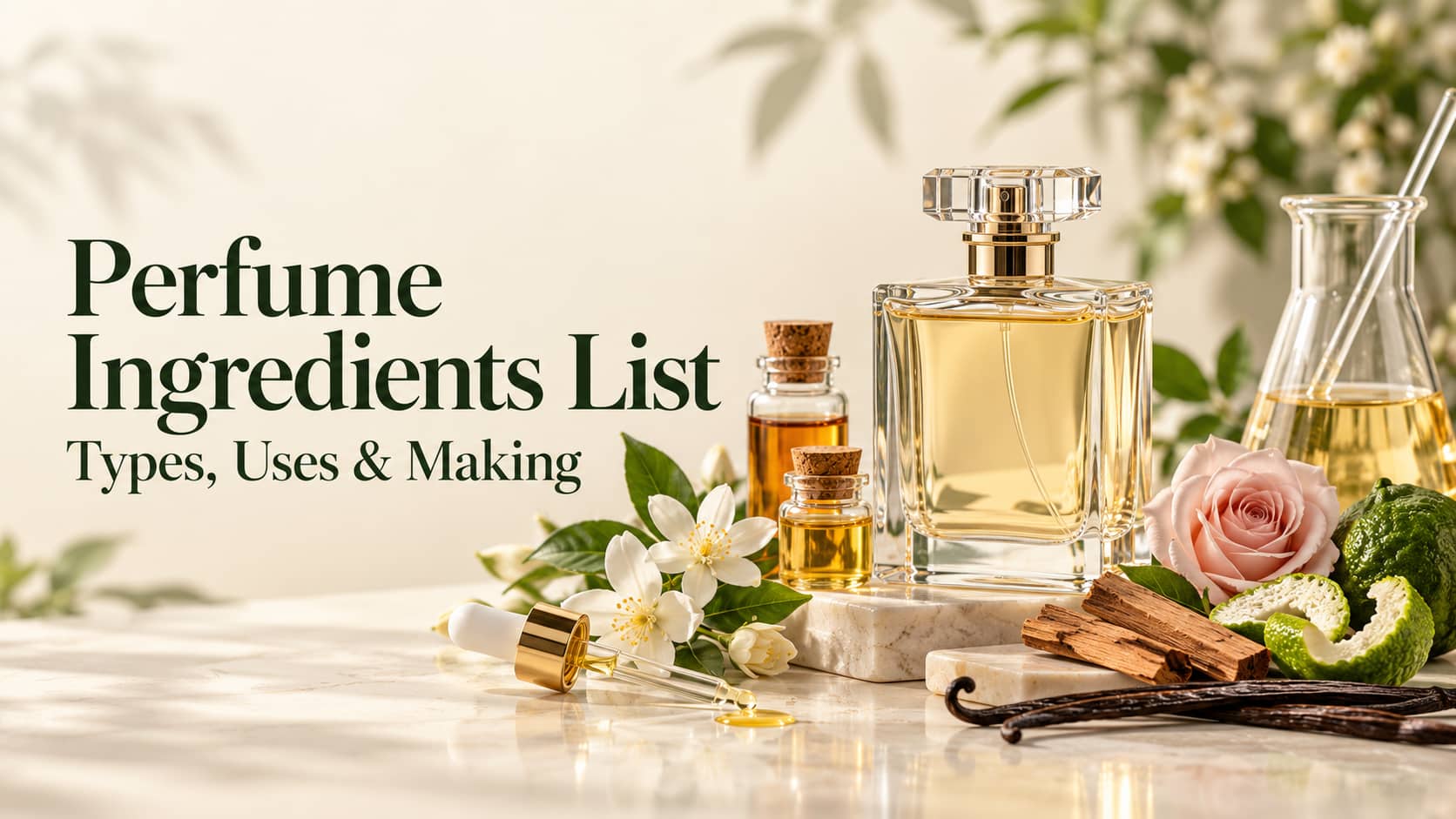
Perfume usually contains a fragrance concentrate blended with alcohol or another carrier. The concentrate can combine essential oils, absolutes, aroma chemicals and long-lasting materials. Some formulas also include water and functional additives.
Understanding a perfume ingredients list helps you distinguish the ingredients that create the smell from those that carry it. For manufacturers, it also connects ingredient selection with consistency, solubility and finished-product performance.
Key Takeaways
· Most spray perfumes contain fragrance concentrate, ethanol and sometimes water.
· Natural extracts and synthetic fragrance ingredients can work together in one formula.
· Scent notes describe an impression; they do not reveal the complete recipe.
· Fixatives support lasting character, but longevity depends on the whole composition.
· Raw-material quality, documentation and application testing matter when buying in bulk.
What Are the Main Ingredients Used in Perfume?
The main ingredient groups are aromatic materials, a carrier and, where needed, supporting additives. There is no universal formula: an alcohol spray, oil perfume and solid perfume require different bases.
The following list of ingredients used in perfume making shows representative examples. A finished perfume will contain a selected combination, not necessarily every material listed.
Ingredient group | Common examples | Main purpose |
Alcohol carrier | Perfumery-grade ethanol | Dissolves compatible aromatic materials and supports spray delivery |
Water | Purified or demineralised water | Adjusts an alcohol-based formula where appropriate |
Essential oils | Bergamot, lavender, patchouli, vetiver | Add complex botanical scent profiles |
Absolutes and resinoids | Jasmine absolute, rose absolute, benzoin resinoid | Supply floral richness, warmth or balsamic depth |
Aroma chemicals | Linalool, geraniol, vanillin, methyl dihydrojasmonate | Build specific scent effects and control composition |
Substantive materials | Selected musks, woody amber materials, resins | Support the lasting scent and dry-down |
Alternative carriers | Jojoba oil, fractionated coconut oil | Carry fragrance in suitable oil-based products |
Supporting additives | Antioxidants, solubilisers or colourants, where needed | Address particular stability or appearance requirements |
These groups overlap. An aroma chemical can provide both a recognisable smell and lasting character. An essential oil contains many molecules, some of which may also be available as individual perfumery ingredients.
What Is the Main Ingredient in Perfume?
In many alcohol-based spray perfumes, ethanol is the largest component by quantity. The fragrance concentrate, however, supplies the perfume's defining smell.
For an oil perfume, a carrier oil may be the largest component. "Main ingredient in perfume" therefore has two answers: the dominant carrier by quantity and the aromatic blend responsible for identity.
Natural Perfume Ingredients: Oils, Absolutes and Resins
Natural perfume ingredients come from sources such as flowers, leaves, fruit peels, woods, roots and plant resins. The plant species, growing conditions and processing method can influence their smell.
Essential Oils Used in Perfumes
Common essential oils used in perfumes include:
· Bergamot oil for a bright, citrus opening.
· Lavender oil for floral, herbal freshness.
· Rose oil for a rich floral character.
· Cedarwood oil for dry, woody structure.
· Patchouli oil for earthy depth.
· Vetiver oil for woody, root-like and sometimes smoky effects.
A perfumer selects a specific grade, not simply a plant name. Two lavender oils can differ in character, and a citrus oil's processing method can affect its suitability for a particular application.
Norex's essential oils collection provides a starting point for exploring botanical raw materials and discussing specifications.
How Are Absolutes Different From Essential Oils?
Essential oils are generally obtained through distillation or, for many citrus oils, mechanical expression. Absolutes are typically produced through solvent extraction and further processing.
Jasmine absolute and rose absolute are examples of materials used for rich floral effects. Resinoids, such as benzoin resinoid, provide balsamic character. These material types should not all be described as essential oils. Essential Oil University's terminology guide explains the distinction.
Aroma Chemicals Used in Perfumery
Aroma chemicals are individual aromatic substances used to create or adjust a fragrance. They may be synthesised, isolated from natural materials or produced through other routes. The chemical name alone does not always establish origin.
Examples of aroma chemicals used in perfumery include linalool for floral freshness, geraniol for rose-like character and vanillin for a sweet vanilla effect. Methyl dihydrojasmonate provides a delicate jasmine-like impression.
Unlike a complex botanical oil, an individual material gives the perfumer a more focused building block. Several materials can be combined into an accord: a blend perceived as a recognisable scent, such as rose or amber.
Synthetic fragrance ingredients expand the available scent palette and can support consistent production. Natural and synthetic materials are frequently combined to achieve a particular creative and technical result.
For examples of how suppliers describe individual materials, see IFF's ingredients compendium.
What Do Perfume Fixatives Do?
Perfume fixatives help support the persistence and balance of a fragrance. The term can describe materials that influence evaporation as well as substantive ingredients that remain noticeable during the dry-down.
Selected musks, woody amber materials and balsamic resins can contribute lasting character. They also have their own odours, so changing a fixative may change the perfume itself.
There is no single additive that guarantees all-day performance. Longevity depends on the composition, concentration, carrier, application and conditions of wear. Adding more heavy material can also reduce the freshness or balance a perfumer intended.
Top, Middle and Base Notes in Perfume
Top, middle and base notes in perfume describe how the scent is perceived as it develops.
Note stage | Typical impression | Illustrative scent examples |
Top notes | The initial impression | Citrus, fresh herbs, sparkling effects |
Middle or heart notes | The central character | Rose, jasmine, floral or spicy effects |
Base notes | The lasting dry-down | Woods, musks, vanilla, balsamic effects |
These stages overlap rather than switching at fixed times. IFF's perfume creation guide explains this layered structure.
A note is not necessarily a literal ingredient. A rose note can come from rose extracts, individual aroma chemicals or a combination. An amber note usually describes an accord, rather than indicating that fossilised amber is present.
How Is Perfume Made From Raw Materials?
Perfume production moves from a scent brief to a tested, repeatable formula. Understanding how perfume is made also explains why ingredient quality alone cannot determine the finished result.
1. Define the brief. Establish the desired scent, product format, target market, cost and performance requirements.
2. Select the materials. Compare odour, purity, origin, availability and suitability for the intended use.
3. Develop the concentrate. Weigh aromatic materials into trial blends and evaluate how they work together.
4. Dilute in the chosen base. Incorporate the concentrate into alcohol or another compatible carrier.
5. Allow the blend to settle. Assess the fragrance after an appropriate resting period; timing varies by formula.
6. Finish and test. Filter where needed, check clarity and stability, assess packaging compatibility and compare the scent with an approved reference.
7. Fill and release. Complete the required quality checks before packing the finished product.
This workflow turns perfume making ingredients into a controlled formulation. Scaling up requires accurate weighing, batch records and repeatable processing, rather than simply increasing a trial recipe by eye.
How to Read a Perfume Ingredients List
A consumer label and a manufacturer's formula serve different purposes. The label communicates ingredients under the rules of the sales market; the formula records the materials and quantities used in production.
Depending on the market, a label may include alcohol, water and a collective fragrance term. It may also name particular fragrance substances. It does not necessarily disclose every component of the concentrate.
The FDA's fragrance labelling guidance explains that US cosmetic labels can declare fragrance mixtures as "Fragrance". Requirements differ across markets, so one country's label should not be treated as a universal template.
An ingredient name also does not prove that it was separately added. A substance can be present as part of an essential oil or another complex raw material.
Buying Raw Materials for Perfume Manufacturing
When comparing raw materials for perfume manufacturing, assess more than price per kilogram. A lower-cost material can change odour, colour or solubility enough to require reformulation.
For essential oils and aroma chemicals used in perfume manufacturing, request:
· Clear identification, including botanical name or chemical identity where relevant.
· A specification sheet and batch-specific certificate of analysis.
· A safety data sheet and relevant allergen information.
· Origin, processing details, storage guidance and shelf life.
· Samples for odour, solubility and finished-formula evaluation.
· Pack sizes, minimum order quantity, lead time and batch traceability.
For fragrance mixtures, request appropriate IFRA conformity documentation for the intended application. For individual raw materials, ask for applicable restriction and constituent information. IFRA explains that its conformity certificate is prepared by the fragrance mixture manufacturer and does not replace a finished-product safety assessment.
To discuss a ready-made or tailored composition, explore Norex fragrance solutions. Its manufacturing capabilities page also outlines facilities relevant to sourcing discussions.
Conclusion
A useful perfume ingredients list explains both what is in perfume and what each material contributes. Carriers deliver the fragrance, aromatic materials define its character, and selected substantive ingredients support its dry-down.
For manufacturers, the next step is to match those materials to a clear product brief. Share your required scent, format, target market and expected volume with Norex to discuss suitable materials or fragrance compositions.