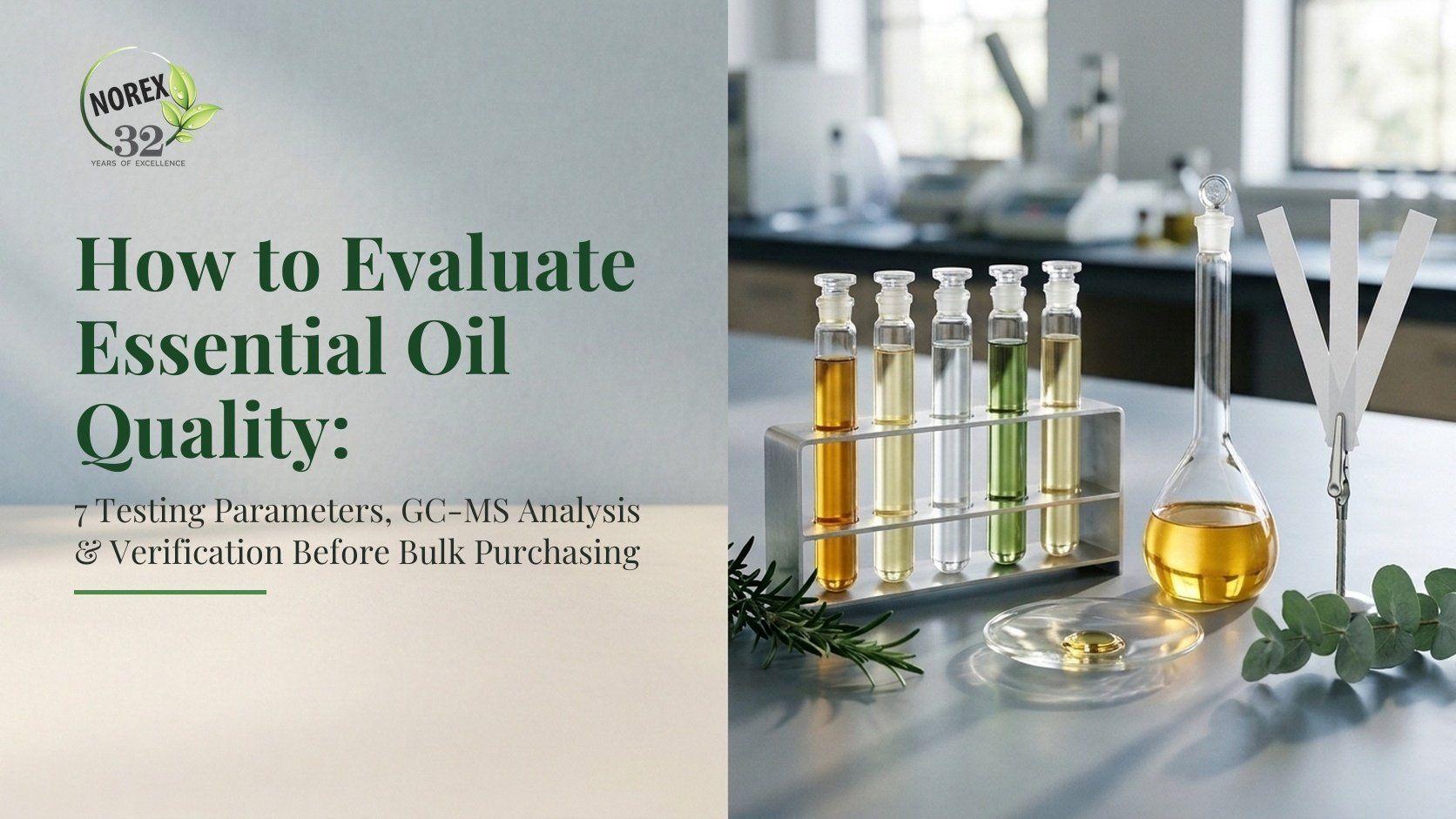
A drum of lavender oil can pass a sniff test and still fail in your formulation. The aroma is close, the color looks right and the price seems like a bargain. Then the finished lotion separates, or the fragrance drifts between batches, and you are stuck with product you cannot ship. Essential oil quality is hard to judge by nose alone, because adulterators blend cheaper or synthetic materials to match what buyers expect. For importers, cosmetic and fragrance manufacturers, and procurement teams, that risk grows with every kilogram ordered. This guide covers the seven parameters to check, the tests that expose adulteration and the documents a serious supplier should hand over before you commit.
Key Takeaways
- Never judge by aroma alone. Adulterated oils are often built to smell right.
- GC-MS is the core test. It shows chemical composition and flags unexpected compounds.
- Physical constants confirm the story. Refractive index, specific gravity and optical rotation should sit inside the specification range.
- Read the COA batch by batch. A certificate without a batch number proves very little.
- Test a pre-shipment sample. Compare it with the approved sample before you release payment.
- Consistency matters as much as purity. Your formulation depends on repeatable results.
- Audit the supplier as well as the oil. In-house labs, certifications and traceability show how quality is controlled.
Why Essential Oil Quality Matters for Bulk Buyers
Essential oil quality decides whether a bulk order performs in your product the way the approved sample did. A cheaper price per kilo rarely makes up for a poor lot.
A single bottle forgives mistakes. A bulk order of essential oils does not. If you buy 200 kg of tea tree oil and the key components are off, every batch of product made with it carries the same flaw. The cost shows up as reformulation, rejected batches and customer complaints, and sometimes as an irritation issue or a label claim you can no longer support.
Natural variation adds to the problem. Crop year, harvest timing, soil and distillation conditions all shift an oil's composition. You need a supplier who controls those variables, and a testing routine of your own that catches whatever slips through.
7 Essential Oil Quality Parameters to Check Before Purchasing
Use these seven checks together. No single number proves essential oil quality, but a pattern of matching results is very hard to fake.
1. Purity and Chemical Composition
A pure oil contains only what the plant and the distillation produce. Compare the supplier's chemical composition with a recognized reference, such as the ISO standard for that oil where one exists. ISO 4730, for example, covers tea tree oil and limits components like terpinen-4-ol and 1,8-cineole. Ask for the specification in writing, with ranges rather than a single average.
2. GC-MS Testing and Analysis
Gas chromatography separates an oil into individual compounds, and mass spectrometry identifies them. The report lists each component with its percentage. Look for the marker compounds of that oil, believable ratios and no unexplained peaks. Lavender is a classic case: synthetic linalool or linalyl acetate can distort the balance, and chiral GC can reveal it because natural and synthetic linalool differ in enantiomer ratio.
3. Refractive Index and Specific Gravity
These are quick physical checks a lab can run in minutes. Refractive index measures how light bends through the oil. Specific gravity compares its density with water at a set temperature. Each oil has an accepted range, and a value outside it points to dilution with carrier oils or solvents. A careful blend can still match both numbers, so treat them as a cross-check on GC-MS, not a replacement.
4. Optical Rotation
Many essential oils rotate polarized light by a characteristic amount because of their chiral compounds. Racemic synthetic additions can pull the reading away from the expected range. It is especially useful for citrus oils and lavender, where adulteration is common.
5. Aroma and Appearance
Smell the oil on a blotter at the start, after ten minutes and after a few hours. A real oil evolves from top notes to base notes. A flat, sharply chemical or fast-fading profile deserves a closer look. Check color and clarity against the specification, and watch for cloudiness, sediment or separation. Run this check blind, against your approved reference.
6. Batch Consistency
Ask for certificates from the last several batches, not only the best one. See how far the major components move. Some natural drift is normal, but wide swings mean you will keep readjusting your formulation. Batch consistency is what turns a good sample into a dependable supply.
7. Packaging, Shelf Life and Storage
Oxidation degrades oils, citrus oils especially. Confirm the container type, fill level and sealing, along with the manufacture date, retest date and storage guidance on the label. An oil that tested well at dispatch can still arrive tired if it sat warm in a poorly sealed drum.
How to Check Essential Oil Purity: Testing Methods and GC-MS Reports
To check essential oil purity, pair a GC-MS report with physical tests and a sensory comparison against a retained reference sample. Essential oil quality testing methods work best in sequence: review the paperwork, test a sample, then confirm the shipment matches.
How to Verify a GC-MS Report
A report is only useful if it can be trusted. Check these points before you rely on it:
The batch number on the report matches the batch you are buying.
The testing lab, date and method are named, ideally with the column used.
Major markers fall inside the specification range for that oil.
Component percentages add up to close to 100 percent, with no large unidentified fraction.
You received the chromatogram, not just a typed table. A table is easy to edit. A chromatogram is much harder to fabricate.
For high-value orders, send your own sample to an independent lab and compare the result with the supplier's report.
How to Identify Adulterated Essential Oils
Essential oil adulteration detection starts with knowing the usual tricks. Suppliers may pass lavandin off as lavender or add synthetic compounds to lift a weak profile. Others stretch the oil with vegetable oil or a solvent, or return stripped fractions in a ratio nature would not produce.
Watch for these warning signs:
- A price far below the market range for that oil.
- A COA with no batch number, lab name or date.
- A GC-MS profile that looks suspiciously perfect, or sits exactly on the midpoint of every range.
- An oily ring on a blotter that does not evaporate, which can indicate a fixed carrier oil.
- Refractive index or specific gravity outside the accepted range.
- A supplier who resists sending a sample or a written specification.
None of these proves fraud alone. Two or three together should stop the order until you have independent test results.
Documents to Request from an Essential Oil Supplier
Essential oil supplier quality standards show up first on paper. Before a bulk order, ask for:
- A Certificate of Analysis (COA) with batch number, test results and specification limits.
- The GC-MS report with chromatogram.
- A technical specification and Safety Data Sheet (SDS).
- The Latin botanical name and country of origin.
- Quality system certificates relevant to your market, such as ISO 9001 or GMP.
- An IFRA statement and allergen declaration if the oil goes into fragrance or cosmetics.
- Shelf life, storage guidance and lot traceability records.
Documents you cannot get before the order will rarely appear after it.
How to Select a Reliable Bulk Essential Oil Supplier
Choose a bulk essential oil supplier for control, not claims. Ask whether the company owns its testing lab, manages distillation and filtration itself, and can trace the plant material back to its source.
As an example, Norex Flavours has supplied flavours, fragrances and pure essential oils since 1994. Its manufacturing capabilities page lists an advanced GC-MS section, a physical chemistry lab, and a microbiology lab, along with ISO 9001:2015, ISO 22000, WHO-GMP, REACH registration, Kosher and Halal certifications. Distillation, fractionation and multi-stage filtration sit under one roof.
Product pages also show the basics a buyer needs. The tea tree oil listing, for example, names Melaleuca alternifolia as the source, Australia as the origin and CAS 68647-73-4.
No supplier suits every oil. Start with a sample, run your own tests, then scale the order once the results hold across more than one batch.
Conclusion: Better Essential Oil Quality Starts Before the Order
Strong essential oil quality is the result of checks, not hope. Verify composition with GC-MS, confirm it with physical tests, read every COA by batch and judge the supplier by how it controls its process. If you are planning a bulk order, request specifications and samples from Norex Flavours and run them through your own testing protocol.